Policy-safe local copy
Local business description guide for AI-readable store pages
A local business description should help customers understand the store quickly. It should also give search systems a stable explanation of what the business offers, where it operates, and how customers can contact it.
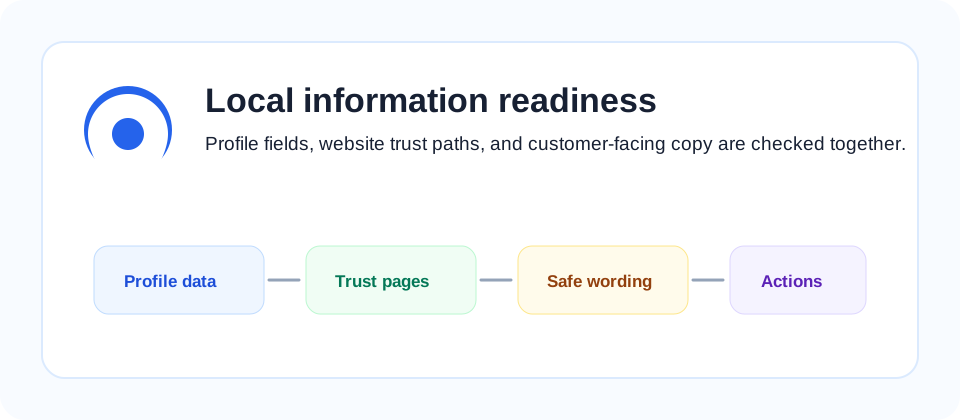
Description structure
Use a clear order: business category, main service, location or service area, customer use case, contact path, and special constraints such as reservation requirements or opening hours. This structure is easy for people to scan and easy for crawlers to interpret.
A strong description starts with facts, then explains fit. The first sentence should tell a new customer what the business is and where it operates. The next sentence can cover the main service categories. A final sentence can explain booking, walk-in, delivery, or consultation rules. This avoids long promotional copy while still giving enough context for local search and AI summaries.
Example writing pattern
Instead of saying "the best local shop," write what the shop actually does: "A neighborhood repair shop in Mapo that handles phone battery replacement, screen repair, and same-day pickup requests." Specific nouns are more useful than promotional adjectives.
Use the same pattern on the website, profile, and service pages. If the profile says "phone repair" but the website says only "digital care," the crawler has to infer the connection. Consistent wording helps the business become easier to understand without stuffing the same keyword into every sentence.
Claims to avoid
Avoid unsupported ranking claims, fake review language, platform affiliation claims, and promises about traffic or revenue. LocalGEO AI also avoids guaranteeing search ranking, because visibility depends on competition, location, profile quality, and platform decisions.
Claims should be either factual, verifiable, or removed. "Open every weekday until 8 PM" is useful if it is accurate. "Trusted by local customers" is weak unless it is supported by real reviews or a clear customer count. "Guaranteed first page ranking" is risky and should not be used in a diagnostic or profile optimization context.
For a technical checklist, read the Google Business Profile readiness checklist and compare policy boundaries in the LocalGEO AI terms.
Review and update rhythm
Review the description when services change, photos become outdated, store hours change, or customers repeatedly ask the same question. A small update log helps the business keep profile copy aligned with the website.
Seasonal businesses should review descriptions before peak periods. Appointment-based businesses should review descriptions when the booking flow changes. Service businesses should review copy whenever new services are added or old services are no longer offered. The goal is not constant rewriting; it is keeping the public description aligned with the real customer experience.
Writing for AI summaries
AI answer systems tend to reuse clear factual sentences. That means the description should avoid clever slogans at the point where a factual answer is needed. Write one sentence that states the business category, one sentence that states the service area or visit method, and one sentence that explains the next customer action. These sentences can be reused on the profile, website, and service page without sounding artificial.
Include constraints that prevent poor-fit leads. If a business requires reservations, handles only certain device models, offers delivery only in selected districts, or cannot answer medical or legal questions online, say that plainly. Constraints are not negative content; they help customers choose the right path and reduce misleading expectations.
After publishing, read the description as if it were quoted alone in a search result. A good description should still identify the business, service, location, and action path without relying on surrounding page design. If it cannot stand alone, rewrite the first two sentences before expanding the rest of the page.
Editing checklist before publishing
Before publishing a business description, remove sentences that could apply to any local business. Phrases such as "friendly service," "best quality," and "customer first" rarely help because they do not identify the business. Replace them with concrete nouns, service names, location cues, appointment rules, or preparation details that a customer can act on.
Then check whether the description matches the page title, profile category, service list, and contact flow. If the title says "local profile diagnostic" but the description talks only about general marketing, readers will not know what happens after they click. If the profile category says "restaurant" but the description emphasizes catering, the mismatch may also confuse search systems.
Use one primary phrase naturally near the beginning, but do not repeat it in every paragraph. Local descriptions need clarity more than density. A better pattern is to use one main category phrase, then supporting phrases that reflect real customer intent: reservation, parking, delivery area, price range, consultation, pickup, repair time, document preparation, or service boundary.
Finally, review the description on a phone. Long paragraphs that look acceptable on desktop can become hard to scan on mobile. Break the copy into short paragraphs, keep the main fact near the top, and make the contact path visible without forcing the user to search the entire page.
For LocalGEO AI, the publishing standard is practical usefulness. The description should be clear enough for a customer, consistent enough for a crawler, and restrained enough for policy review. That combination is usually stronger than aggressive promotional copy.
For platform-specific profile rules, check Google's business information guidance.
For search-facing page quality, compare descriptions with Google's helpful content guidance and Search Central snippet guidance.